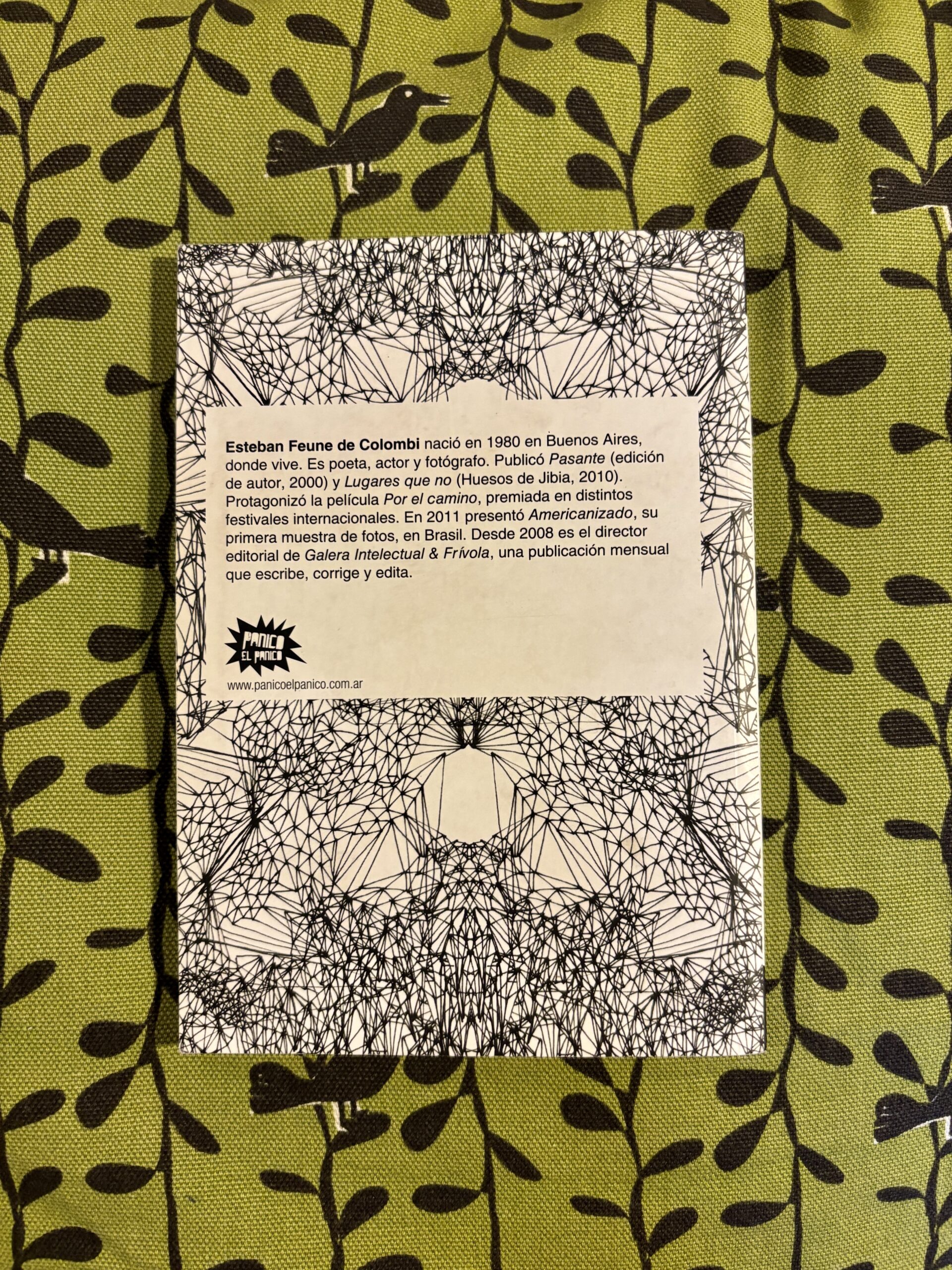
No recuerdo (2011)
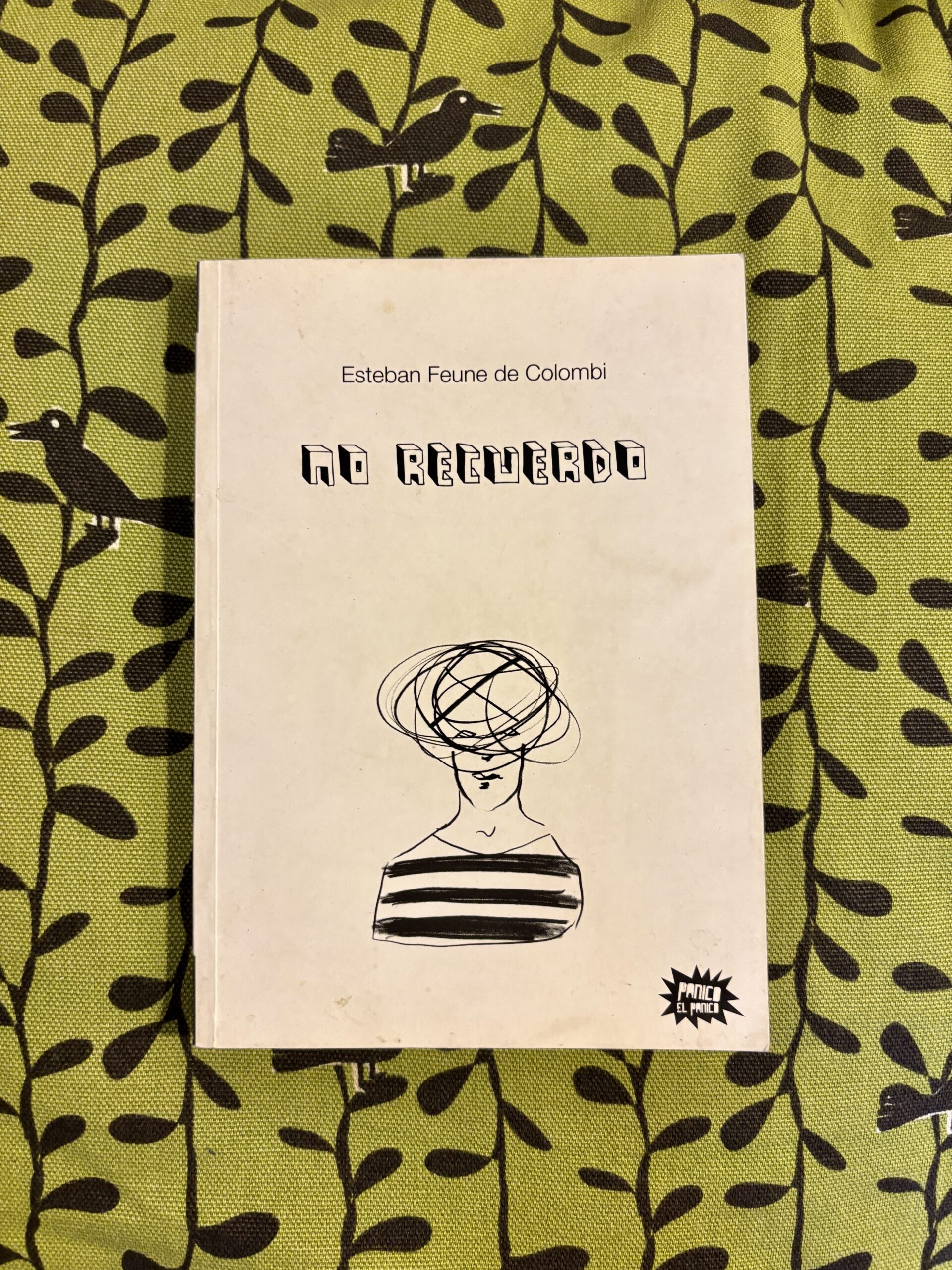
Title: No Recuerdo | Publisher: Pánico El Pánico | City: Buenos Aires | Year: 2011
Repercussion
The cataloging principle of Feune’s book is, fortunately, as mysterious as the mystery of the woman Feune does not remember. It responds to an even more mysterious principle, which Feune obeys without amnesia: that of elegant solutions, which surely the math teacher
who threw chalk at him and laughed in his face did not teach him. By the first one we can detect how much Feune remembers despite the titular impudence, not how, which is perhaps a non-collateral effect or a defect of forgetfulness that the principle of elegant solutions imposed. With memory, perhaps we cannot say and all is always now, even if it serves me as a paradox: with memory is perhaps the only one with which we can repeat like a mantra the Eliotian formula.
Like the circumstance that accompanied Ortega’s “I” (and perhaps tangentially that of Gasset), memory follows in the footsteps of Feune de Colombi, Esteban, and plainly, plainly and simply assembles this combinatory of reticulated celebration. Yes, that is what Esteban Feune de Colombi’s book is, plain and simple.
But I am not writing this prologue to define or classify but because No memory awakened in me happiness. Not because the transmission found -let’s try to emulate my ignorance of his youth with the beautiful clumsiness of his dismemory- an analogous operating system nor because we could -so later Feune and I- share memories but because oblivion, like passion, is a passion: it commands. There would be something like a neurosis of shared Latin American destiny if I were to say to oblivion: mande. And it is not a kindness on the part of Esteban Feune to forget par délicatesse many things that together we have forgotten, but to remember many others that we have also forgotten. Thus, and in the end, a brilliant novel is told, strategically. Thus finds its scansion a speech, a babbling (come to my aid, St. John of the Cross), a babbling. Thus erases the I the fingerprints of the abusive experience. Thus erases Funes his Ireneo. “Here my steps / warp their incalculable labyrinth”: lobe, tantrum.
I could write the aporia of Miles Davis, who always seemed to me to be born overrated, like Picasso, with whom he is so often, and for such obviously exaggerated reasons, compared. Jimi Hendrix usually played an inverted Stratocaster (he was left-handed); the inversion, the fact that the longest flipper – or whatever it was called – of the guitar was in a supine position, about to jump up and away – antelope, cheetah – added an attimo of supreme elegance to the invisible performance. Before I get exhausted, I must say that I enter the “panting” stage of the prologue, that I read and reread No recuerdo, that I love No recuerdo, that I consider it one of the most admirable intimate intensities of this decade, of this beginning of the century.
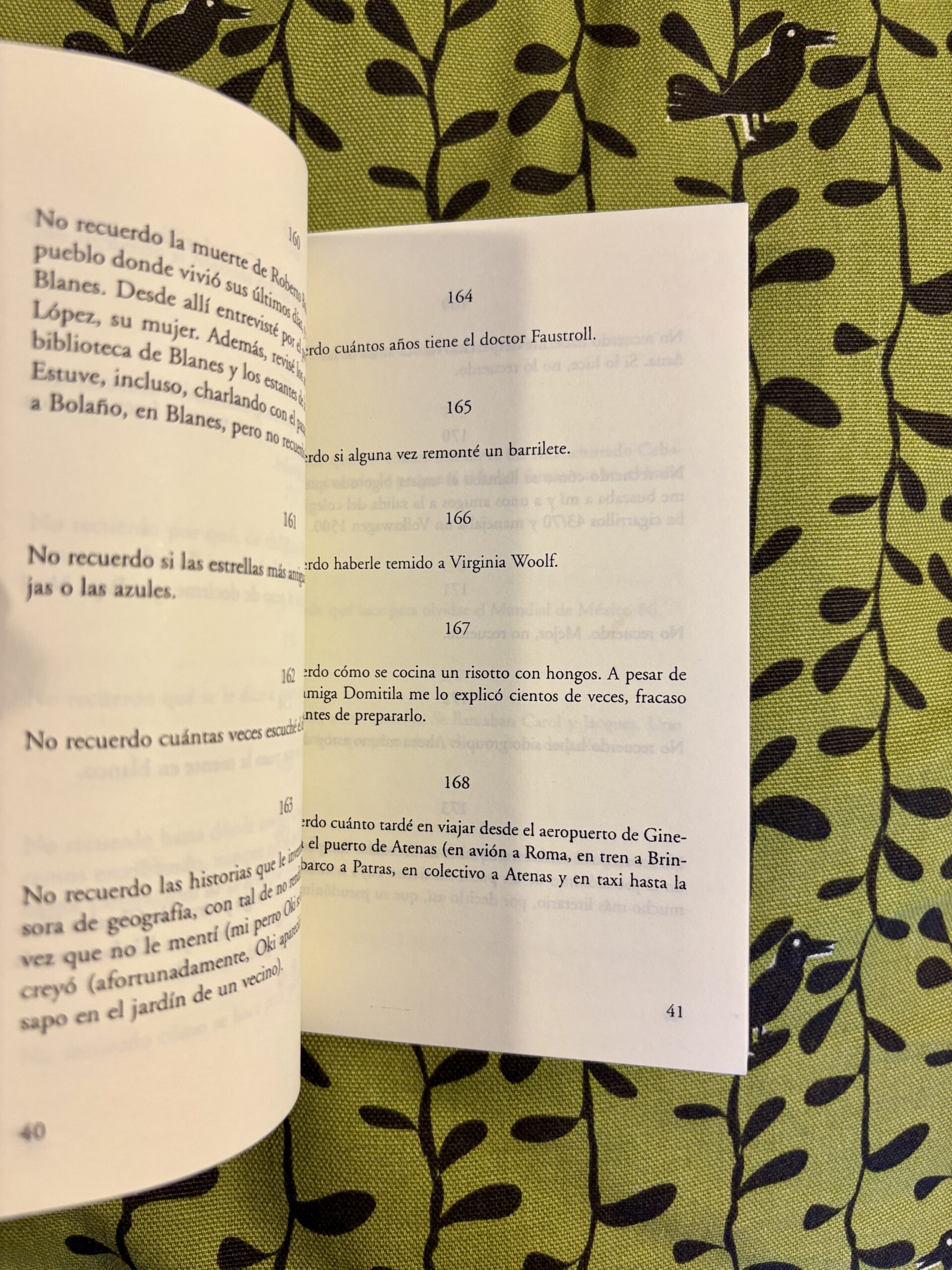
I do not remember, however, how old Esteban Feune is. I don’t remember a better title to repeat to a bookseller who demands precision. I don’t remember how many characters I had left to write. We live, as we should, with the uncertainty of being grateful for what is missing or what is left over. We consequently contract a double debt of gratitude with this light, light -voluntarily timid, voluntarily modest- precipitation of genius.
Luis Chitarroni (foreword to the book)
